terça-feira, 29 de janeiro de 2019

‘Dr. Pimple Popper’: How Much Money Did Dr. Sandra Lee Make in Her First Months on YouTube?

Dr. Sandra Lee of Dr. Pimple Popper got her start by posting videos of her removing blackheads on Instagram and YouTube. Her YouTube then really took off to where it was a full-on business exposing that there is a demand for these kinds of videos as entertainment. But what was she making before her videos took off? Here is everything you need to know.

Dr. Sandra Lee made $30 from her first month on YouTube

Before reality television, Dr. Sandra Lee would pop her patients' pimples and post videos of them on YouTube. The patients were typically in her office anyways for other things, but she would offer the pimple-popping service for free in exchange for her to anonymously film them. The business paid off but it still took some time.

The dermatologist revealed that she really had to work her way up to getting the success she eventually got on YouTube. She told People, "The first month I made $30 or something. Then the next month I did it again and made $300. Then the next month it was in the thousands."

There are reports that she made hundreds of thousands per year in 2016

The doctor got as many as 350 million views on her videos. Since the videos have ads and are monetized that has led to a lot of money. The Sun reported she made as much as $4,350 every day from her videos. Another report by The Cut reported she made hundreds of thousands a year in 2016.

Part of that success was probably tapping into something that interest people and not a lot of videos providing that. She also teamed up with other YouTube stars like Logan Paul and removed a cyst for him to get more fans.

There are some pimple-popping videos on YouTube that aren't done by medical professionals. Dr. Sandra Lee revealed why she doesn't watch them.

"I don't know if the environment was clean, or if the person was in pain," she told Hello Giggles. She also revealed another thing she can't stand to see. "I can't watch anyone else's popping videos," Dr. Lee told Mashable. "Don't send them to me. I will not watch them. I cannot even look at them. Never, never send me like, a horse abscess or something. That is disgusting to me."

She then continued, "Non-human bothers me … They can't tell you they're in pain. How do I know someone's not numb? I know my patients are numb, and comfortable, and [they're in] a sterile clean area."

So Dr. Sandra Lee made $30 the first month she was on YouTube and eventually, she got thousands of dollars per year from the platform. Now the doctor has many avenues of income with her skincare line, book, and TV show. She also has no plans watching other people's videos.

Read more: Can You Get an Appointment with Sandra Lee from 'Dr. Pimple Popper'?

Check out The Cheat Sheet on Facebook!

Super Bowl hero John Riggins now fighting to get more money for older NFL retirees

ARLINGTON, Va. â€" It has been nearly 36 years since John Riggins produced one of the greatest clutch runs in football history with a 43-yard touchdown rumble on fourth and inches against Miami â€" kids, check out that stiff-arm on YouTube! -- that propelled Washington to victory in Super Bowl XVII.

Now “The Diesel” is still running … with a different purpose.

The Super Bowl XVII MVP is revved up about the still-persistent quest by retired players from his era to increase their pensions, which pale when compared to more recent retirees and current players. 

“It appears the NFLPA and their constituents are only worried about themselves, and, â€˜Sorry, guys, just die, will you please? Go away,’ " Riggins, 69, told USA TODAY Sports during a recent group interview that included his wife, Lisa Marie, and several former teammates. “That’s kind of the feeling you get.”

As another Super Bowl looms, with yet another appearance by Tom Brady and Bill Belichick on tap, there’s also a “Groundhog Day” effect when it comes to aging ex-players looking for a bigger piece of the NFL pie. They’ve been at it for decades, in one form or another, frustrated that those who played before the major sea change in the NFL’s system occurred in 1993 â€" when liberalized free-agency and a salary cap were instituted â€" are in a markedly lower class for benefits. This, while the most robust sports league in the land continues to grow, with revenues exceeding $14 billion per year.

Compare the pension of, say, Hall of Fame guard Joe DeLamielleure, around $30,000 per year, with the $220,000 maximum for similarly vested retirees of Major League Baseball or the NBA who played in the 1970s, and the concerns of the ex-players resonate.
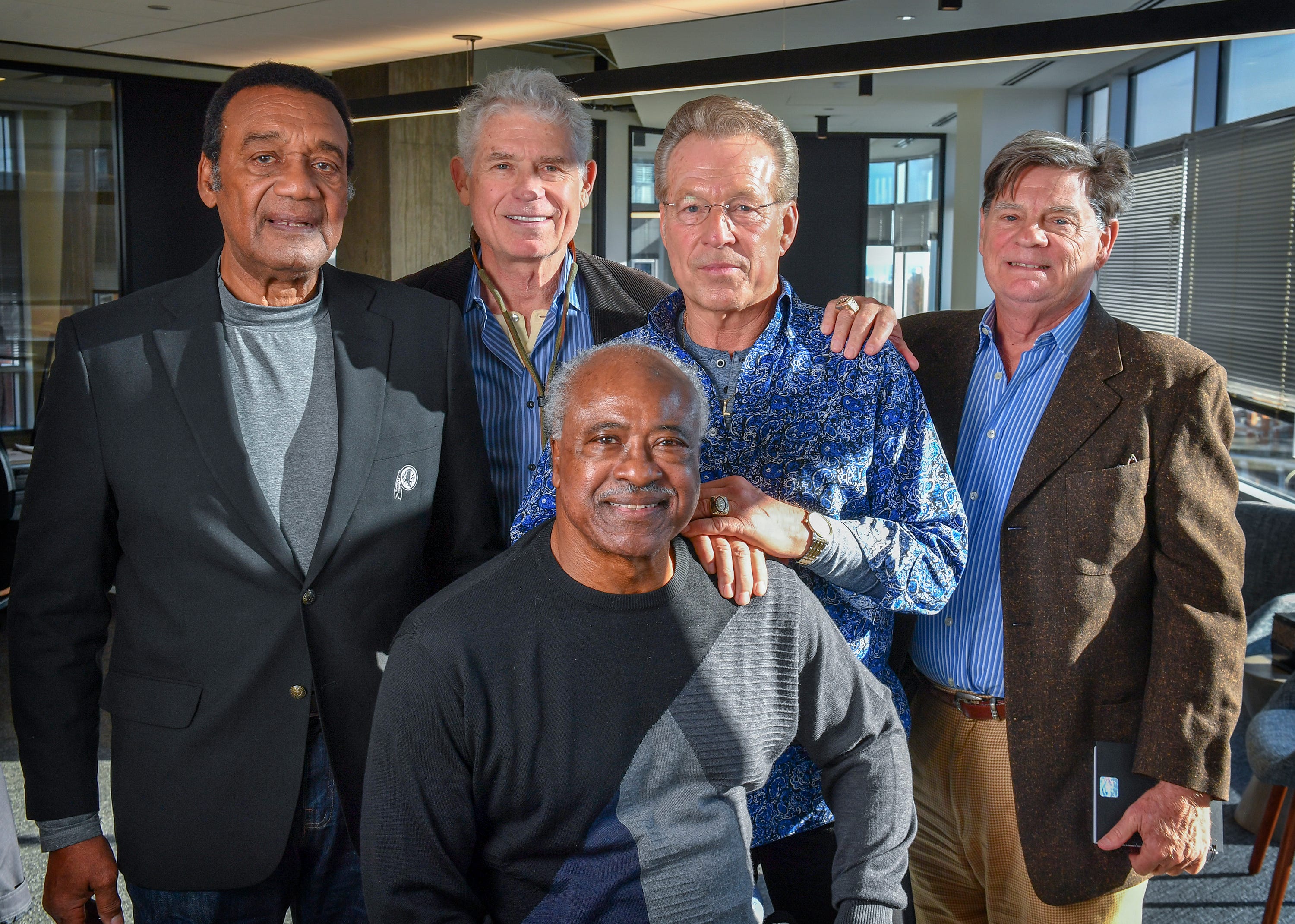
Former Washington players (L-R) Roy Jefferson, John Riggins, Larry Brown, Mark Moseley and Mike Bragg support Riggins and his wife, Lisa Marie, who are at the forefront of a campaign to improve benefits for retired NFL players.

But here’s the big problem for the pre-'93ers: Like the last time and multiple times before, they won’t have a seat at the bargaining table when the NFL and NFLPA negotiate to extend the current collective bargaining agreement that expires after the 2020 season.

So, among efforts by others (such as Hall of Fame legend Eric Dickerson), a reformulated approach now flows through a non-profit entity, Fairness for Athletes in Retirement (FAIR). Headed by attorney Lisa Marie Riggins, FAIR has embarked on a campaign aimed to educate the public and current players in advance of those next CBA talks.

The group is raising operating funds through online donations (pensionparity.com) and has private donor events in the works in several NFL markets. It’s all essentially an appeal to altruism, bolstered by the hope that public pressure, in addition to engaging the NFLPA, will lead to significant increases for roughly 4,000 former players in the pre-’93 class.

“One of the important things in appealing to the union and the current players is that they’ve held themselves out now as social justice warriors,” Lisa Marie Riggins said. “So I think the timing is perfect to make our case. I say to them, ‘Look inside your very own house,’ because there’s some justice that can be done.”

Of course, current players and NFLPA leadership have a different view. When the last CBA was struck in 2011, active players contributed more than any group of players ever to the pre-’93 cause â€" largely through the $620 million “Legacy Fund” that was funded jointly with NFL owners.

Yet the current players are challenged by a lingering perception that, with salaries that dwarf those of previous generations, they lack empathy for the pioneers.

“Active players have increased pensions and benefits for former players under every collective bargaining agreement,” former Falcons linebacker Dewey McClain, a member of the NFLPA’s executive board, noted in an e-mail to USA TODAY Sports. “People overlook the fact that active players not only pay for benefits, but that today’s players pay a higher percentage of their salaries toward pension than in any other era. Former players are most effective when we unite to have NFL owners contribute to the pensions of former players like we did in 2011.”

Lisa Marie Riggins allows that the NFLPA doesn’t have a fiduciary duty or legal duty to their cause. Yet she contends there is a “moral duty,” as roughly 140 players per year from the pre-’93 class die â€" and there is no shortage of hardship cases of former players dealing with financial and physical challenges.

“I see it first-hand,” said Mark Moseley, 70, who in 1982 became the only pure kicker in NFL history named the league’s MVP. He now heads the Washington Redskins Alumni Association. “I know that they need help … so that they don’t have to get on their hands and knees and beg. That’s just not right for guys who played and gave their hearts.”

Even so, this is hardly a business environment where it’s typical for retirees who were, for example, autoworkers, technical engineers or teachers, to go back to former employees to negotiate new pensions, years later. If FAIR succeeds, and more power to them, it would buck the trend that has existed for over a decade as traditional pensions are frozen or slashed, if they exist at all, often replaced by 401(k)s or other retirement-saving vehicles.

“What’s the problem? We’re the ones who put it together,” said former receiver Roy Jefferson, 75. “We’re the ones who started free-agency. We’re the ones that started the benefits program. And we’re the ones left in the cold.”

According to Lisa Marie Riggins, the pre-’93 class has received just one cost-of-living increase in 38 years â€" which came with the aforementioned “Legacy Fund.” According to the NFL, the fund boosted the monthly pension for a 10-year veteran who played during the 1970s, for example, from $165 per month to $1,810. Other benefits include programs that address assisted living, joint replacement, spine treatment and discount prescriptions.

Yet listen to former players and they will tell you that without lifetime medical coverage and other resources, it is far from enough. And they still feel disenfranchised by the dividing line that is 1993.

“The other leagues â€" hockey, baseball, basketball â€" they all realize that the pioneers deserve the same thing their current guys get as far as the retirement (benefit) goes,” John Riggins said. “I’d say that’s a pretty small chip when you think about it.”

Karen Friedman, executive vice president and policy director of the Pension Rights Center, has heard similar themes before. The Washington, D.C.-based group once advocated with Johnny Unitas for the same purpose.

“If the NFL is making record profits,” Friedman told USA TODAY Sports, “there’s no reason why it shouldn’t want to raise the pensions of those who helped build the league.”

If so, perhaps the model was exhibited with the “Legacy Fund,” with both owners and the players' union contributing as an aside to their labor negotiations â€" albeit without the pre-'93ers having a seat at the table. Remember how the late Gene Upshaw, a Hall of Fame tackle who ascended to head the NFLPA, infuriated former players years ago by declaring that he represented current players â€" and not former players.

Smith, who has often talked of supporting the pioneers since first elected in 2009, inherited that animosity as part of his job. While the intensity hasn’t risen to the level that it did with his predecessor, he probably won’t win any popularity contests with the pre-’93 players, either.

Which fuels irony. Many of the pre-’93 players participated in the four player strikes during the '70s and '80s â€" which ultimately led to the class-action lawsuit settled with the 1993 CBA and system overhaul that brought about free agency.

Now those former NFLPA members, decades after their labor battles, still seek more benefits.

Riggins sees it like this: “We robbed the bank and they spent the money.”

Follow Jarrett Bell on Twitter @JarrettBell.

This article originally appeared on USA TODAY: Super Bowl hero John Riggins now fighting to get more money for older NFL retirees

quarta-feira, 23 de janeiro de 2019

You can make money on YouTube

Jerome Stone Youtube Channel.Photo Submitted by Darrien Alexandra Fordham.

YouTube is one of the fastest growing online platforms for young adults between the ages of 18 and 24. Content creators such as Jake Paul, 22, Daniel Middleton (DanTBM), 27, and Jeffree Star, 33, are listed among the top 10 YouTube earners, making between $18 and $21.5 million a  year between their channels, endorsements and company collaborations.

Since YouTube was originally created for amateur content, people of all ages have started channels posting specific content such as make-up tutorials, reaction videos, movie reviews and so much more.

Jerome Stone, a student at FAMU, plans to use his YouTube channels for profit.

"The inspiration is I used to do other stuff on TV, like back when I was a kid, and everyone tells me that I should've kept going with it, so YouTube was my way partially back into that path," Stone said.

Since its humble beginnings in 2005, YouTube is one of the largest growing social media platforms in the world. YouTube, once started as a place to upload random videos, has now turned into a market that profits off of shows, movies and other entertainment outlets.

With its increased popularity, YouTube has played a large role in decreasing traditional television's views, specifically for young adults.

A common myth is that one can profit off of YouTube videos based on views of their video. In actuality, Youtubers make a profit only off of their ads. According to videopower.org, a Youtuber will profit off of a video depending on if the viewer interacts with the ad or watches the ad for at least 30 seconds. Typically, one must have at least one thousand subscribers for YouTube to start automatically uploading ads to videos.

"You are more likely to get more ads on your videos if it's over a 10 minute video … and if you are a consistent poster the shorter ads that [the viewer] can't skip through will post on your channel," Stone said.

In addition, the Youtubers earning the most money do so by being sponsored by companies and advertising products. Essentially, becoming a hired spokesperson for a company, which is commonly seen in the make-up industry.

For example, Jeffree Star, who has 12 million subscribers, collaborated with the high-end make-up company BH Cosmetics and now has used his own platform to create his own line of make-up products. He has also filmed videos with celebrities such as Kim Kardashian.

Stone advises those who are new to YouTube to "post consistently and just do it. It's really not as hard as people make it sound; you 've got to start from somewhere or you're not going to get anywhere."

sexta-feira, 18 de janeiro de 2019

How to earn more money on YouTube? Here’s how you can do it.

The change in policies on YouTube has made many YouTubers ineligible for monetization during the last year. The problem arose for YouTubers when Google changed its YouTube Partner Programme. Managing social media and making money through blogging has become difficult for bloggers. Their earnings have come down – revenues are falling. YouTubers will now be needed to have many more subscribers and viewership to earn money. Earlier, however, a YouTuber needed to have only 10,000 views to become eligible for monetizing their content on YouTube. With the revised policy, now, to become eligible, a creator needs to get 4,000 hours of watch time within the past 12 months and also have at least 1,000 subscribers.

While this move has come as disheartening news for new creators, experts suggest, they should use it as a motivating factor to raise their bar. Praval Sharma, a tech YouTuber (with channels, Sharmaji Technical, and Sharmaji Infinity), says, "As Internet data became affordable, many new creators entered YouTube. People started making money through videos that did not add any value." Industry experts say, trying out options like sponsorships, merchandising and affiliate marketing helps creators who are serious in this platform and make value additional videos. With all these changes, find out what you can do to increase your reach and earn more.

How does it work?

After a creator gets monetized, YouTube shares a portion of its revenue that it generates from running ads on user-generated content with the creators. It is divided in 45:55 ratio, where YouTube keeps 45 per cent of the revenue while the creator gets the balance 55 per cent.

What can you do?

Experts suggest YouTubers should concentrate on one thing at a time, and adopt a focused strategy. For instance, many YouTubers, even popular ones, used to run multiple channels. After the monetization change last year, many of them have also fallen prey to the new policy as most of them too have not crossed the threshold limit. Such YouTubers then focussed only on one channel, their primary one which they thought had the best chances of crossing the monetization threshold. To make that one eligible for Google's new monetization criteria they abandoned all of their other channels.

You can also look at other options, within the platform. For instance, the YouTube platform offers multiple other sources of income besides its primary source, AdSense. Other options include sponsorships, merchandising and affiliate marketing.

  • Sponsorship gets a little difficult for new creators. To get brand sponsorships, you need to build your reach first. Brands don't sponsor new creators. They only approach people with a decent number of subscribers. YouTubers who have good reach with higher views and subscribers, brands readily sponsor such bloggers. Those brands then pay to review their products.
  • Through affiliate marketing, you need to put a link of the product or service you are reviewing in the description box. If your viewers go to the product site by clicking on that link in your description, you will receive a commission.
  • YouTube ads, on the other hand, are served only on advertiser-friendly contents. Creators making advertiser-friendly content get more advertisement offers from YouTube. Hence, if you produce advertiser-friendly content, you are likely to get more advertisement offers.
  • Similar to YouTube, other social media platforms like Facebook, Twitter or Instagram also work in the same way. These social media platforms can also get you brand sponsorship if you have a good reach there. Experts add new people planning to make a career out of social media blogging should try and work to enhance their reach on other media platforms. This way they can earn brand sponsorships on different platforms other than YouTube.

    Get live Stock Prices from BSE and NSE and latest NAV, portfolio of Mutual Funds, calculate your tax by Income Tax Calculator, know market's Top Gainers, Top Losers & Best Equity Funds. Like us on Facebook and follow us on Twitter.

    quinta-feira, 17 de janeiro de 2019

    Slim Budget? Here's What To Spend Money On When Starting A Freelance Business

    [unable to retrieve full-text content]There are a plethora of YouTube videos on how to start a WordPress site. Wix and Squarespace are other "drag and drop" website builders that may be easier to set up. Invest in teachings that won't bre...

    terça-feira, 15 de janeiro de 2019

    How to earn more money on YouTube? Find out

    The change in policies on YouTube has made many YouTubers ineligible for monetization during the last year. The problem arose for YouTubers when Google changed its YouTube Partner Programme. YouTubers will now be needed to have many more subscribers and viewership to earn money. Earlier, however, a YouTuber needed to have only 10,000 views to become eligible for monetizing their content on YouTube. With the revised policy, now, to become eligible, a creator needs to get 4,000 hours of watch time within the past 12 months and also have at least 1,000 subscribers.

    While this move has come as disheartening news for new creators, experts suggest, they should use it as a motivating factor to raise their bar. Praval Sharma, a tech YouTuber (with channels, Sharmaji Technical, and Sharmaji Infinity), says, "As Internet data became affordable, many new creators entered YouTube. People started making money through videos that did not add any value." Industry experts say, trying out options like sponsorships, merchandising and affiliate marketing helps creators who are serious in this platform and make value additional videos. With all these changes, find out what you can do to increase your reach and earn more.

    How does it work?

    After a creator gets monetized, YouTube shares a portion of its revenue that it generates from running ads on user-generated content with the creators. It is divided in 45:55 ratio, where YouTube keeps 45 per cent of the revenue while the creator gets the balance 55 per cent.

    What can you do?

    Experts suggest YouTubers should concentrate on one thing at a time, and adopt a focused strategy. For instance, many YouTubers, even popular ones, used to run multiple channels. After the monetization change last year, many of them have also fallen prey to the new policy as most of them too have not crossed the threshold limit. Such YouTubers then focussed only on one channel, their primary one which they thought had the best chances of crossing the monetization threshold. To make that one eligible for Google's new monetization criteria they abandoned all of their other channels.

    You can also look at other options, within the platform. For instance, the YouTube platform offers multiple other sources of income besides its primary source, AdSense. Other options include sponsorships, merchandising and affiliate marketing.

  • Sponsorship gets a little difficult for new creators. To get brand sponsorships, you need to build your reach first. Brands don't sponsor new creators. They only approach people with a decent number of subscribers. YouTubers who have good reach with higher views and subscribers, brands readily sponsor such bloggers. Those brands then pay to review their products.
  • Through affiliate marketing, you need to put a link of the product or service you are reviewing in the description box. If your viewers go to the product site by clicking on that link in your description, you will receive a commission.
  • YouTube ads, on the other hand, are served only on advertiser-friendly contents. Creators making advertiser-friendly content get more advertisement offers from YouTube. Hence, if you produce advertiser-friendly content, you are likely to get more advertisement offers.
  • Similar to YouTube, other social media platforms like Facebook, Twitter or Instagram also work in the same way. These social media platforms can also get you brand sponsorship if you have a good reach there. Experts add new people planning to make a career out of social media blogging should try and work to enhance their reach on other media platforms. This way they can earn brand sponsorships on different platforms other than YouTube.

    Get live Stock Prices from BSE and NSE and latest NAV, portfolio of Mutual Funds, calculate your tax by Income Tax Calculator, know market's Top Gainers, Top Losers & Best Equity Funds. Like us on Facebook and follow us on Twitter.

    segunda-feira, 14 de janeiro de 2019

    YouTube still wants gamers to ‘earn money’ — and provide content

    YouTube is going through some growing pains as it tries to balance its history as one of the most important platforms to the democratization of content creation and its current status as a highly valued partner for brands and advertisers. The latter wants some insulation from the behaviors of the former — especially after some brands found they were ending up next to videos featuring people making sympathetic jokes about Nazis. In response to those concerns, YouTube has created a new monetization status that indicates a certain video is eligible for advertising but it is also "not suitable for all advertisers." This has started to appear next to almost any video featuring a modern shooter game (like Call of Duty or Battlefield 1), and sometimes it appears for no obvious reason at all. This has the vast community of gaming YouTube creators anxious and confused, and that prompted the video site to speak up with a forum post addressing user fears.

    In the post, YouTube Gaming boss Ryan "Fwiz" Wyatt wrote that the company understands the problems, and it has already made some steps to improve the process.

    "In the last few months we spent time addressing concerns from advertisers around where their ads are placed," wrote Fwiz. "With new controls and guidelines implemented, many creators have seen their earnings return to normal as advertisers resumed their campaigns. As a part of these recent changes, however, some videos were classified as not suitable for all advertisers, limiting the number of ads served on those videos. There was also no ability to directly appeal in Video Manager. So on August 7th, we announced that we've expanded the ability for creators to appeal videos that have been receiving fewer ads. "

    Fwiz wrote that if see the yellow icon, you should appeal.

    "With 400 hours of video uploaded every single minute, we rely on machine learning to evaluate content across the platform," Fwiz explained. "But no system is perfect. When you appeal, our reviewers take a look and their decisions help our systems get smarter over time."

    YouTube is also reiterating that violent video games on their own are typically not enough to permanently brand a piece of content with the yellow monetization emblem. The company previously provided guidelines that explain only videos that are explicitly about gratuitous violence or over-the-top profanity should earn that tag. So, again, if you're just uploading a match of PlayerUnknown's Battlegrounds, you should feel ready to appeal if YouTube's system blocks most ads.

    Appealing will also help YouTube's machine-learning algorithms get better at only flagging truly inappropriate videos in the future, so it could get the service to a point where you don't have to worry about going through this hassle in the future. But as of today, YouTube's A.I. moderators are costing creators money. Valve News Network, a YouTube channel that covers all things related to Valve Software, posted a video yesterday about the Half-Life 3 prototype map. The video has more than 400,000 views as of the time of this posting … and it was marked as "Not suitable for all advertisers." Tyler McVicker, the person responsible for the Valve News Network, vented on Twitter that he doesn't understand why it was marked as inappropriate.

    McVicker is also not happy with Fwiz's response.

    "It doesn't fix any of the issues I have or bring up," McVicker explained in a note to GamesBeat. "I wasn't emailed when [YouTube] flagged it. I don't know why it was flagged, specifically. And I have lost over 400,000 views of revenue, which is the largest I would have ever earned in my career."

    McVicker has requested a review of his video, but he'll have already missed out on the bulk of his revenue by then. And he likely still won't know what triggered the bots so that he can avoid doing something similar in the future. It appears YouTube still has problems to solve.

    For now, however, YouTube wants to talk about other ways for creators to get paid for their work.

    "We're very focused on creating more ways for gamers — and creators of all kinds — to earn money on YouTube," said Fwiz. "That's why we acquired FameBit to help creators partner with brands and why we're experimenting with sponsorships in the YouTube Gaming app. We even launched Super Chat so that your biggest fans can give you money for serving up chicken dinners while live streaming PUBG."

    But for most YouTube affiliates, none of that could replace revenue sharing from advertising, and the company acknowledged that.

    "In all seriousness, we have teams of partner managers, engineers, and product managers, not to mention one of the biggest salesforces around, whose entire job is to make sure that creators — including gamers — find success on our platform by monetizing videos with advertisements," said Fwiz. "The gaming community has been a central part of YouTube's success from the very beginning. With hundreds of millions of fans watching hundreds of billions of minutes of gaming videos every month, gaming has never been bigger on YouTube than it is today. We're proud to be the home of gaming and know that the community will continue to play an important role in YouTube's future."