In May 2016, Fisayo Fosudo did three things he had never done before. He took an Uber ride, filmed a conversation with the driver and published the video on YouTube. Inspired by that first video, after saving enough money (more than $5,000 USD), Fisayo bought video production gear and published his first tech video in November. “I had no idea if I was doing the right thing, if this thing was going to pay off or if I just wasted all my money for nothing,†he remembers.
It’s now almost two years since that first Uber video and I’ve met Fisayo for lunch to find out how things have been going.
The end of the year festivities can still be felt, and the restaurant where we’re meeting, like the mall where it’s located, is filled with lots of people including crying children. “I just knew that if I was really going to commit and start making videos, I had to root it in reality somehow. There’s no way I’ll have video gear just lying around and not get to work.â€
You probably won’t get a lot of eye contact when you meet the soft-spoken 23-year-old economics graduate for the first time. His journey has taken him from being a self-taught freelance graphic designer to doing brand development for MAX.ng, one of Nigeria’s earliest logistics startups, and now making tech videos on YouTube for a living.
As one of a handful of Nigerian YouTubers making tech-focused content on YouTube, Fisayo credits his introduction to technology to his maternal uncle. “Back then, we lived at my grandma’s in Ajegunle and anytime my uncle came around I remember he’d always have the latest Apple gadget,†Fisayo recalls. “He wasâ€"and still isâ€"obsessed with Apple products and use to let me play with them.â€
Much like his uncle, Fisayo also has an affinity for Apple products, except the Apple Watch, of which he says he’s not a fan. What he is a fan of, and spends a lot of his free time on, is binge-watching Netflix shows, listening to house music (he’s obsessed with electronic dance music dj MAR+IN GARRI×) and playing video games.
Apart from his uncle, Fisayo said his “incubation†at MAX was the most instrumental to getting him to where he is now. “I learnt so much at MAX, you can’t even imagine. They really helped me grow and develop,†he said.
“When I had free time between doing my national service in Ogun State and working at MAX, I decided to try my hands at video and there is no better platform to start out on than YouTube. After that first video I just made stuff from time to time with gadgets I could find but there wasn’t any consistency.â€
Fisayo isn’t the first to use YouTube as a storytelling medium, but the earliest Nigerian YouTubers were not based in Nigeria. YouTubers like Ikenna Azuike (2007), Tolulope Ogunmefun aka DntJealousMe (2008) and Grace Ajilore (2009) were based in the UK with Emmanuel Iwueke aka MrCrazeclown (2010) publishing from Ukraine. They all published content either centered around their personal lives or comedy.
As internet penetration grew, internet access became cheaper and smartphone usage increased, more and more Nigerians, this time living in Nigeria, started to launch their own channels. First came traditional media houses like television station ChannelsTV and entertainment platform HipTV, both of whom launched YouTube channels in 2011. Then celebrities like on-air personality Toke Makinwa, make-up artist Dimma Umeh and the popular RealNollywoodClips, followed in 2012.
Since that time a new crop of Nigerian YouTubers are deviating from the typical comedy or personal vlog content to build niche audiences for themselves. Fisayo Fosudo belongs to this new group of Nigerian YouTube publishers.
It wasn’t until March 2017 that Fisayo’s YouTube journey properly began. His earlier videos were weeks apart and there wasn’t any consistency in his contentâ€"something that is crucial for success, or at least growth, in the YouTube universe. Up until that point, he made tech videos using gadgets and devices he owned personally. But he didn’t think this was the most sustainable way to grow.
“I sent a DM on Twitter to Tecno’s marketing manager at the time, Jesse Oguntimehin, asking if they could give me a device to review and included my ‘What to expect’ video. He was like ‘Cool, come pick up the device.’ I was so happy. When I published the video, it just blew up!†he shares, still perplexed by Oguntimehin’s response.
When he started, Fisayo had no idea how he was going to make money on YouTube. He wasn’t even sure he could make money. Being a YouTube creator is not only hard work, it’s also not very financially rewarding. If you’re broadcasting from Nigeria, your direct earnings don’t come from YouTube.
“I started doing this because I wanted to do something different. It wasn’t about money,†Fisayo shared with me. “I have about $800 in lifetime earnings but I can’t access it. The real money doesn’t come from YouTube, it comes from the brands that we work with creating content for an audience.â€
In 2018, Fisayo worked with 18 different brands and while he won’t share specifics on how much the brands pay him, other YouTubers have confirmed they charge between N150-N200K (about $415-550 USD) on average for videos. At N200K per video, a YouTuber that creates four brand-sponsored videos in a month will make N800K. That’s a lot more money than they can earn directly from YouTube.
YouTube’s complex ad generation model and publisher CPM (cost per milleâ€"mille is Latin for thousand) formula is influenced by many factors from location to location. The CPM is the amount of money advertisers pay each time their ad reaches a thousand views. So if a CPM is $1 then it means $1 will be paid for every 1,000 advertisement impressions generated, but there could be fluctuations from month to month.
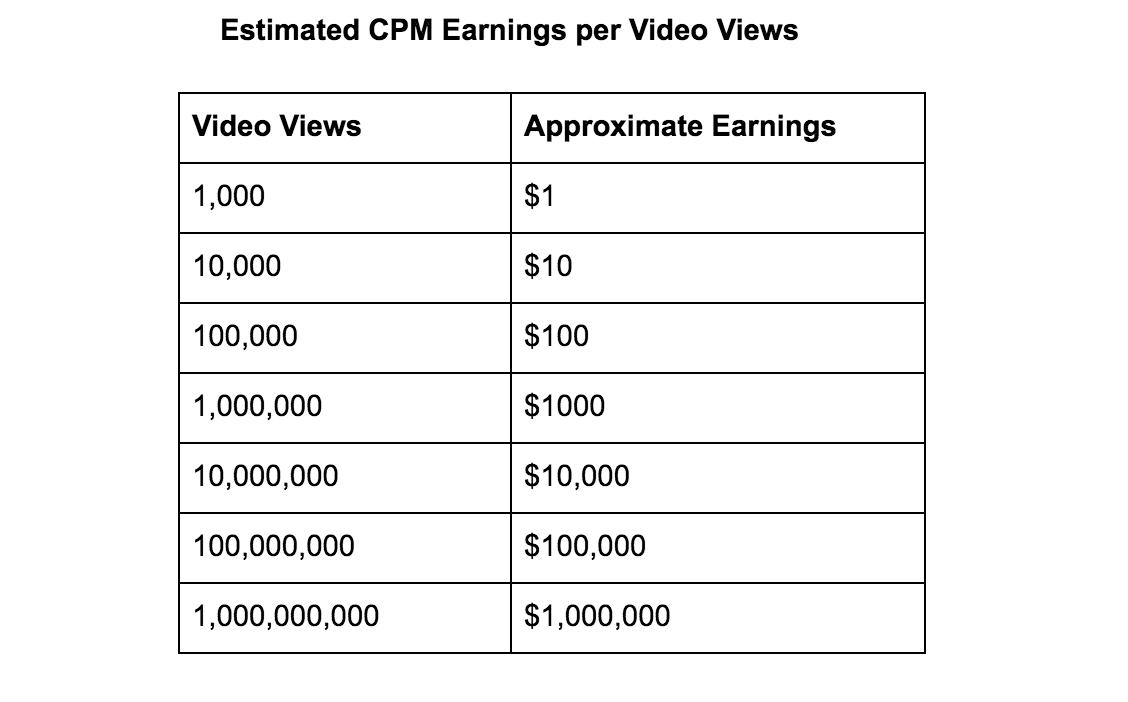
Source: TechCabal
In comparison, top YouTubers in the U.S. and Europe make millions off the platform. The list is exclusively male, and half of the top-earning YouTubers share a focus on video games. Collectively, the 10 top-earning YouTubers in those regions take home more than $180 million a year. Of course, CPM rates are higher in those regions and YouTubers can make money off things like merchandise. Also, brands typically pay huge sums to have these creators as ambassadors.
Growing viewership has proven to be difficult for Fisayo as data costs are still high. Data speeds are also not great and, in Fisayo’s opinion, user habits like skipping videos pose a threat to his livelihood. To get past these challenges, he has made hefty investments in multiple ISPs, video gear and power generators.
A little over two years since he created his channel, Fisayo has 26K+ subscribers, 75 published videos and over 1.3 million views. From a global outlook, these numbers aren’t that impressive but in Nigeria, they stand out if compared to other Nigerian YouTubers. Those that have better numbers than Fisayo, like Yemisi Odusanya, a lifestyle vlogger who has 168K subscribers, 531 videos, and 18.4 million views, have been on the platform longer than Fisayo and published more videos.
New-found popularity and economic status aside, Fisayo doesn’t consider himself successful yet. “I guess to a lot of people I am but I don’t know. I feel like there is still way more to do before I can say I’m successful. It’s great to be able to afford my own place and car now but it’ll probably be a better idea to come back to that question in a few years.â€


0 comentários:
Postar um comentário